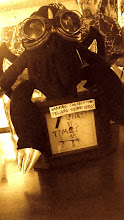
Ah, the days finally came when the mainstream media caught on to the existence of Burning Man.
How typical the reaction.
Countercultural experiment. Hedonistic "festival". Art and Music "festival". Disneyland for adults. An event run by an exploitative for-profit. "Burning Man goes mainstream!" A hippie extravaganza.
From the mainstream press propaganda, you'd think that a bunch of loser hippie wannabees gather suicidally in the desert to act weird, stupid and everything in between.
But wait! Could it be possible that the public that isn't already familiar with what Burning is might be being misled? Gasp!
Then what oh what could this satanist gathering* on a salt flat be?
BURNING MAN.
The Man that Burns. Literally, a tall wooden effigy of a hominid male that is lit on fire by humans, who gather and share the experience of standing around something they created so that they could destroy it together.
THAT is Burning Man. Shockingly simple, I know - and surprisingly devoid of lights, music, costumes, drugs, nudity, sex, police, alcohol, etc. etc. etc. In other words, devoid of all the things that the mainstream media, having decided to finally care about Burning Man this year, has used to sensationalize (and therefore stereotype) the event.
And those things you read and see about ARE happening, have no doubt. But the point of the event, from its humble beginnings on a beach in San Francisco twenty-five some odd years, is nothing more than just that simple first paragraph.
Yet what is truly remarkable is how powerful such a simple act can be. For in that space, where we share an immediate moment like watching something burn, we create an instant human community that unlocks the most primal aspects in all of us: that of sitting around a fire and simply being human together.
And that is the kernel from which the most remarkable human experimental community in recorded history has come about; a celebration of the immediacy, honesty, compassion and expression that comes standard with every model of homo sapiens sapiens. Features that our modern hyper-rational, alienated society has seemed to forgotten or strives to actively repress.
So how do you go from a handful of people standing on a beach in San Fran watching a jumble of logs burn to a 50,000 person experiential event in the exact middle of nowhere? What the hell could attract so many people to an admittedly barren wasteland to spend time with other people of equal or greater questionable mental health?**
Perhaps the simplicity of creating and participating in a community that Tolerates, Accepts, Explores, Respects and Creates?
Because that is the simplicity of the attraction - as powerful and potentially life-changing as it can be for the many that attend it and that have attended it in the past. When we as humans gather together voluntarily - when we allow ourselves to be challenged by nature in the raw - when we create and share for the purpose of destruction - we engage with our own fundamental humanity. Something that our sheltered, individuated, consumption-driven, cut-throat, repressed culture has strayed too far away from.
People come for thousands and tens of thousands of miles to ultimately stand on the dried bed of a salt lake to watch a tall wooden effigy burn after a week of trying to reconnect with what it means to be human BECAUSE Being Human has become a challenge, if not an impossibility, in our "normal lives".
That's why they Burn. That's why I Burn. So remember that when you read the spin, the slant and the stereotypes in your paper, online and watch it on TV.
And whenever you want to come and engage with Being Human again, you're always welcome.
;-)
*Its actually not satanist. That's a joke. The nearby residents, before they decided that the loved Burning Man, were afraid that it was a satanist gathering... approximately twenty years ago.
**Actually, the vast majority of people that are there are quite responsible - mainly because they have to be as a requirement to survive in the desert. In fact, quite a few attendees are people of significant responsibility out "in the real world" - people that keep you safe, run your businesses and schools and keep society functioning. It is possible to attend Burning Man and be a pillar of the community; shocking as that may seem to certain Puritanical sensibilities.
Showing posts with label paradigm change. Show all posts
Showing posts with label paradigm change. Show all posts
Sunday, September 11, 2011


Saturday, September 25, 2010
New Podcast: Inception and Paradigm Change, Part 2 Chapters 1 and 2
The conclusion of my podcast concerning the movie Inception and how a paradigm evolves and chances is now available. Its so good, I had to break it into two parts.
techv.dyndns.org/eqn_podcast.xml
techv.dyndns.org/eqn_podcast.xml
Wednesday, August 18, 2010
Tuesday, July 6, 2010
Sunday, February 7, 2010
Shamanism, Materialism and Paradigm "Warfare" Pt. 2
So after a slightly longer than expected pause thanks to the near meter of snow we received this month, let's get back to our narrative. I think I've laid out the problem well enough, and since enough breath has been spent laying out this exact same problem in enough other corners, let's get down to what we really all want to hear about: a solution.
("A" solution - I don't claim this to be "The" solution, just for those of you keeping track of semantics at home.)
Now in a way, we already have one - at least in a dogmatic sense. The mantra of Reduce, Reuse, Recycle is the simplest and most effective matrix to approach 'stuff'. However, the problem with dogma (religious or otherwise) is that it doesn't stick in the human mind in a constructive way: its the bastard child of understanding and belief. Its what we resort to when reason and faith fail - not when they succeed. So Reduce, Reuse, Recycle is too often used as a substitution for explanation and engagement by institutions and NOT as a tool to guide us (as communities) to become better decision-makers.
But it is, and should be, so much more. Because at the heart of this simple little phrase is a very powerful redefinition of our approach to the things in our life. The word that we quickly glide past in considering this is the first one - "Reduce". Obviously, for those of us living in modern industrial Western society, this is a concept that most of us have no comprehension of. I look around my desk, which I struggle to keep free of clutter, and am confronted with an assault on my senses by THINGS. There are things everywhere, of all types and levels of importance. Thanks to my vigilance, I purge most of the "noise" out of my life - and prevent as much as I can from entering it - but I admit freely that I'm not nearly as successful as I NEED to be. There's still more data hitting my optic nerve than I want each time I glance around.
And I say NEED not just for the sake of the planet, but for my own well-being. Each extra thing in my life is one more thing to worry about. Whether I'm worried about what that thing represents, or what its there to remind me to do, or whether its in the way of something else, or how I'm going to pack it up when I move, or how I'm going to keep it from getting broken; its HERE and has some pull on my attention. Every thing that we add into our lives has a story to tell about its addition into our life, plus its connection to other stories, and a reminder about something or someone at some level of meaning to us.
One of the great contradictions of our era of industrial mass production is that we have dramatically increased quantity while simultaneously stripping away value. The ruling logic of mass production is to shove out as much of something as quickly as possible - which clearly lends itself to a level of quality that will ensure that customers are forced to purchase the same item repeatedly down the road. The things that we own do end up owning us, for all the time, money and attention we have to give to them, to the exclusion of so much else in our lives. Our energy is increasingly directed towards things, not people (including ourselves).
And the Real Cost to us and the to planet of such an approach is high: much higher than we the cost we pay as the purchase price. Energy and resource costs (which are often hidden by subsidies or externalized from the transaction), combined with ecological and social costs of generating this tsunami of under-valued commodities create a terrible hidden cost burden on us that we do end up paying, usually with usurious interest.
And the loss of time in generating, moving, cataloguing, warehousing, utilizing and disposing of it all means far less time to devote to more useful activities, whether productive or pleasureable.
Imagine how much time would be saved if you never received another piece of junkmail? Consider the organization (or organizations) that create it - both the creative side and the phsyical side. Someone's time goes into getting that mail into envelopes, of acquiring postage, of cataloguing costs. Then it has to be given to a mail carrier - whose time is devoted to receiving it, distributing it and delivering it. All to have you, the end consumer, pick it up - look through it, decide whether to dispose of it or not, and then do so. And then there's the waste company that picks up your waste, processes it and finally recycles, inters or burns it.
The time, productivity, brain cycles and stress that go into the continuation of this and so many processes like it constitute a TREMENDOUS loss of human value. And we're not even talking about trees, barrels of oil, or pounds of ink. Wouldn't you be MUCH happier to never receive more junk mail? Of course you would! Because it wastes your time and reduces the quality of life. And as with junk mail, so too does the tsunami of valueless things that flood into and overwhelm our lives.
So when we consider Real Cost vs. Real Value, it would appear obvious Reducing is one of the most sensible approaches for pushing that equation back in our favor, personally and collectively. But that statement in itself is not sufficient to win the day here. This is not a complete solution to the problem - but it opens the door understanding what I'm about to lay on you in the next post.
Stay tuned...
("A" solution - I don't claim this to be "The" solution, just for those of you keeping track of semantics at home.)
Now in a way, we already have one - at least in a dogmatic sense. The mantra of Reduce, Reuse, Recycle is the simplest and most effective matrix to approach 'stuff'. However, the problem with dogma (religious or otherwise) is that it doesn't stick in the human mind in a constructive way: its the bastard child of understanding and belief. Its what we resort to when reason and faith fail - not when they succeed. So Reduce, Reuse, Recycle is too often used as a substitution for explanation and engagement by institutions and NOT as a tool to guide us (as communities) to become better decision-makers.
But it is, and should be, so much more. Because at the heart of this simple little phrase is a very powerful redefinition of our approach to the things in our life. The word that we quickly glide past in considering this is the first one - "Reduce". Obviously, for those of us living in modern industrial Western society, this is a concept that most of us have no comprehension of. I look around my desk, which I struggle to keep free of clutter, and am confronted with an assault on my senses by THINGS. There are things everywhere, of all types and levels of importance. Thanks to my vigilance, I purge most of the "noise" out of my life - and prevent as much as I can from entering it - but I admit freely that I'm not nearly as successful as I NEED to be. There's still more data hitting my optic nerve than I want each time I glance around.
And I say NEED not just for the sake of the planet, but for my own well-being. Each extra thing in my life is one more thing to worry about. Whether I'm worried about what that thing represents, or what its there to remind me to do, or whether its in the way of something else, or how I'm going to pack it up when I move, or how I'm going to keep it from getting broken; its HERE and has some pull on my attention. Every thing that we add into our lives has a story to tell about its addition into our life, plus its connection to other stories, and a reminder about something or someone at some level of meaning to us.
One of the great contradictions of our era of industrial mass production is that we have dramatically increased quantity while simultaneously stripping away value. The ruling logic of mass production is to shove out as much of something as quickly as possible - which clearly lends itself to a level of quality that will ensure that customers are forced to purchase the same item repeatedly down the road. The things that we own do end up owning us, for all the time, money and attention we have to give to them, to the exclusion of so much else in our lives. Our energy is increasingly directed towards things, not people (including ourselves).
And the Real Cost to us and the to planet of such an approach is high: much higher than we the cost we pay as the purchase price. Energy and resource costs (which are often hidden by subsidies or externalized from the transaction), combined with ecological and social costs of generating this tsunami of under-valued commodities create a terrible hidden cost burden on us that we do end up paying, usually with usurious interest.
And the loss of time in generating, moving, cataloguing, warehousing, utilizing and disposing of it all means far less time to devote to more useful activities, whether productive or pleasureable.
Imagine how much time would be saved if you never received another piece of junkmail? Consider the organization (or organizations) that create it - both the creative side and the phsyical side. Someone's time goes into getting that mail into envelopes, of acquiring postage, of cataloguing costs. Then it has to be given to a mail carrier - whose time is devoted to receiving it, distributing it and delivering it. All to have you, the end consumer, pick it up - look through it, decide whether to dispose of it or not, and then do so. And then there's the waste company that picks up your waste, processes it and finally recycles, inters or burns it.
The time, productivity, brain cycles and stress that go into the continuation of this and so many processes like it constitute a TREMENDOUS loss of human value. And we're not even talking about trees, barrels of oil, or pounds of ink. Wouldn't you be MUCH happier to never receive more junk mail? Of course you would! Because it wastes your time and reduces the quality of life. And as with junk mail, so too does the tsunami of valueless things that flood into and overwhelm our lives.
So when we consider Real Cost vs. Real Value, it would appear obvious Reducing is one of the most sensible approaches for pushing that equation back in our favor, personally and collectively. But that statement in itself is not sufficient to win the day here. This is not a complete solution to the problem - but it opens the door understanding what I'm about to lay on you in the next post.
Stay tuned...
Wednesday, January 27, 2010
Shamanism, Materialism and Paradigm "Warfare" Pt. 1
Happy January 27th everyone. Not that we need a reason to celebrate, but I'm sure everyone can think of a reason as good as another to be happy.
So, as you may have gathered already - I am taking a very No Fear approach to the topics discussed here. You may sometimes wonder how certain topics relate to end-state sustainability, but rest assured that there is a form of method to my madness. Trying to evolve the human condition forward sufficiently to exist in a state of equilibrium with the planet's ecology requires more than just a tame discussion of technology, science and economics.
The last post regarding politics, specifically political convergences - or at least the birth of a new political paradigm in the United States - is one of those areas that is simply unavoidable in order to have a complete discussion. This post delves even deeper down the rabbit hole into the area of human psychology, culture and *gasp!* spirituality.
So brace yourselves. You've been warned.
Now, part of the inspiration for the topic and title of this post is a workshop I attended this past weekend, concerning basic shamanic practices (provided by the Foundation for Shamanic Studies). It was a "hands-on" affair, which I found particularly rewarding and insightful. And while I am a trained Anthropologist, my approach was participant first and foremost, with "observer" a distant second. Having had some time to reflect and be somewhat more systematic in my consideration of my experience, I wanted to reflect a little on the experience and its relation to human progress towards end-state sustainability.
I will confess that one of the first things I was inspired to do was write a six page rebuttal of the Anthropological community's smirking condescension towards non-modern cultural practices and their proponents. Particularly because taking part in shamanic practices certainly sheds more light on most pre-modern cultural belief systems and human myth than the years of study and research that I've done. But that is far outside the bounds of what I want to focus on here.
The real crux of this post comes down to human paradigms - that is to say, the intellectual and psychological filters that our cultures bestow upon us due to our presence in them. Its clearly been said to death that our post-modern Westernized Globalized culture is highly materialistic. And it should be pointed out that materialism is not inherently vile - from a reasoned perspective Western materialism has directly contributed to the techological and scientific acheivement that we currently have. Furthermore, Western culture's focus on materialism diverted its attention from the contentious issues revolving around religion that nearly destroyed Europe (and still threaten world peace, I might add).
BUT (there's always a "but"), materialism in its current form has become as destructive as the other paradigms it has been trying to displace. Everything else aside (socially, spiritually, politically, etc.), our current obsession with stuff and acquiring more of it has A) bankrupted us financially, and B) is destroying the ability of the planet's ecosystems to support us.
I don't know about you, but being broke and dead is not my idea of a winning solution.
The other easy lay up is the parallel quest in Western civilization to reject materialism. And this is not merely the provence of New Age ideas, this goes back through the many groups and ideas (many some derivative of Christian), past Jesus, and at least all the way to Plato. Unfortunately for this view, rejecting the material world does not make it go away. It has this amazing quality of tenaciousness that has proven to be quite nettlesome for many thinkers and social reformers.
And of course, regarding problems A) and B) above, there are many people in this country who reject materialism (at least in speech) and use this as rational to not care about problems A) and B) (particularly B). If you believe that God has tells you to be "in this world, but not of it", that makes it much harder to sell you on the idea of changing your life ways in order to do something good for that world.
It may not be strange to therefore imagine that perhaps the solution to the problem is a Kantian synthesis of these two paradigms? Which sounds great - until you have to sit down and reason out how that actually would work.
Because it would seem to me that we have some sort of dysfunctional synthesis already. We are surrounded by stuff - are bombarded by stuff, and are practically drowning in it, yet at the same time we shovel it out into the trash about as fast as we bring it into our lives. Its incongruous to believe that would love a thing if we make it deliberately in order to get rid of it. Disposability is a characteristic of a thing that you want to get out of your life.
But more ludicrous is that we make things that are disposable, yet are incompatible with the ecosystems from which we've extracted them. So we take value out of Nature, screw with it, ruin it, use it and then dump it back into Nature where it makes a bigger mess of things.
This isn't just unsustainable - this is pathological.
If this paradigm of thinking were a patient, and I was the psychiatrist - my diagnosis would be an obsessive-compulsive disorder driven by a fear resulting in self-destructive tendencies. Its like we're trying to save ourselves from the material world by destroying it before it corrupts us - ensuring our own demise in the process.
So again, not a healthy synthesis.
In Part 2, I'll talk about my ideas for "a cure".
So, as you may have gathered already - I am taking a very No Fear approach to the topics discussed here. You may sometimes wonder how certain topics relate to end-state sustainability, but rest assured that there is a form of method to my madness. Trying to evolve the human condition forward sufficiently to exist in a state of equilibrium with the planet's ecology requires more than just a tame discussion of technology, science and economics.
The last post regarding politics, specifically political convergences - or at least the birth of a new political paradigm in the United States - is one of those areas that is simply unavoidable in order to have a complete discussion. This post delves even deeper down the rabbit hole into the area of human psychology, culture and *gasp!* spirituality.
So brace yourselves. You've been warned.
Now, part of the inspiration for the topic and title of this post is a workshop I attended this past weekend, concerning basic shamanic practices (provided by the Foundation for Shamanic Studies). It was a "hands-on" affair, which I found particularly rewarding and insightful. And while I am a trained Anthropologist, my approach was participant first and foremost, with "observer" a distant second. Having had some time to reflect and be somewhat more systematic in my consideration of my experience, I wanted to reflect a little on the experience and its relation to human progress towards end-state sustainability.
I will confess that one of the first things I was inspired to do was write a six page rebuttal of the Anthropological community's smirking condescension towards non-modern cultural practices and their proponents. Particularly because taking part in shamanic practices certainly sheds more light on most pre-modern cultural belief systems and human myth than the years of study and research that I've done. But that is far outside the bounds of what I want to focus on here.
The real crux of this post comes down to human paradigms - that is to say, the intellectual and psychological filters that our cultures bestow upon us due to our presence in them. Its clearly been said to death that our post-modern Westernized Globalized culture is highly materialistic. And it should be pointed out that materialism is not inherently vile - from a reasoned perspective Western materialism has directly contributed to the techological and scientific acheivement that we currently have. Furthermore, Western culture's focus on materialism diverted its attention from the contentious issues revolving around religion that nearly destroyed Europe (and still threaten world peace, I might add).
BUT (there's always a "but"), materialism in its current form has become as destructive as the other paradigms it has been trying to displace. Everything else aside (socially, spiritually, politically, etc.), our current obsession with stuff and acquiring more of it has A) bankrupted us financially, and B) is destroying the ability of the planet's ecosystems to support us.
I don't know about you, but being broke and dead is not my idea of a winning solution.
The other easy lay up is the parallel quest in Western civilization to reject materialism. And this is not merely the provence of New Age ideas, this goes back through the many groups and ideas (many some derivative of Christian), past Jesus, and at least all the way to Plato. Unfortunately for this view, rejecting the material world does not make it go away. It has this amazing quality of tenaciousness that has proven to be quite nettlesome for many thinkers and social reformers.
And of course, regarding problems A) and B) above, there are many people in this country who reject materialism (at least in speech) and use this as rational to not care about problems A) and B) (particularly B). If you believe that God has tells you to be "in this world, but not of it", that makes it much harder to sell you on the idea of changing your life ways in order to do something good for that world.
It may not be strange to therefore imagine that perhaps the solution to the problem is a Kantian synthesis of these two paradigms? Which sounds great - until you have to sit down and reason out how that actually would work.
Because it would seem to me that we have some sort of dysfunctional synthesis already. We are surrounded by stuff - are bombarded by stuff, and are practically drowning in it, yet at the same time we shovel it out into the trash about as fast as we bring it into our lives. Its incongruous to believe that would love a thing if we make it deliberately in order to get rid of it. Disposability is a characteristic of a thing that you want to get out of your life.
But more ludicrous is that we make things that are disposable, yet are incompatible with the ecosystems from which we've extracted them. So we take value out of Nature, screw with it, ruin it, use it and then dump it back into Nature where it makes a bigger mess of things.
This isn't just unsustainable - this is pathological.
If this paradigm of thinking were a patient, and I was the psychiatrist - my diagnosis would be an obsessive-compulsive disorder driven by a fear resulting in self-destructive tendencies. Its like we're trying to save ourselves from the material world by destroying it before it corrupts us - ensuring our own demise in the process.
So again, not a healthy synthesis.
In Part 2, I'll talk about my ideas for "a cure".
Subscribe to:
Posts (Atom)